Showing posts with label Atrophic scar macules. Show all posts

Thursday, June 23, 2011

Get Rid Of Scar !!!


In most cases, once you have a scar, you can’t ever erase it completely. But, whether or not people seek treatment depends greatly on the location of the scar and the extent of the damage. It’s easy enough to overlook a scar on the thigh, but marks on the face or upper body can be distressing. Most scars are more of a nuisance than a serious problem, but if you’re really bothered by a scar, you have a few options:

    Topical treatments. While there’s still debate over how effective creams and ointments are with fading scars, ingredients like hydroquinone can help to lighten discoloration and are found in a variety of skin products.

 Product picks: Mederma is a well-known scar product that comes in a variety of formulas, including one that’s kid-friendly. In addition, Kelo-cote Scar Gel is designed specifically for keloid scars, and Goldfaden Arnica and Vitamin K helps with both scarring and bruising.

 Makeup. Luckily, today’s makeup can hide even the worst scars. Look to green-tinted concealers for acne marks, waterproof makeup for lasting coverage and body concealer for concealing larger scars.

 Product picks: Amazing Cosmetics Amazing Concealer Light Golden is a long-wearing, waterproof formula; Dermablend Leg and Body Cover Medium is useful for larger areas needing cover-up; B. Kamins Booster Blue Corrective Concealer neutralizes redness as it conceals.
  
 Surgery. Professional procedures can change the shape of a scar so it isn’t as noticeable. Options include skin grafts, excision, dermabrasion or laser surgery. But remember that with raised scars, like hypertrophic or keloid scars, you might want to avoid surgery because of the potential for further scarring.

 Injections. Dermal fillers can be a temporary fix for pitted scars.

Remember that although you can help make your scar less noticeable, you can’t make it disappear. Treatment goals should focus on fading discoloration and making the scar less noticeable, not erasing it – so be patient with your scar treatment.

Friday, April 22, 2011

Types with Thrashing Of Skin Tissue

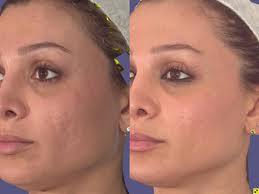
How to treat scarring and skin damages resulted from acne is of great concern to patients with moderate to severe acne. Failed or inadequate treatment of acne is a major cause in development of scarring

Acne spots:

Flat discolorations either brown or red.They are more likely to fade away either gradually without treatment or using fading creams. Post inflammatory pigmentations are classified in the same category. Blocks of pink hyperpigmentations seen following skin breakouts and more likely prolonged acne.

Ice-pick lesions, rolling scars, box car scars: they all associated with some degree of depression in the skin but the shape of the scar within the skin is different. For icepick scars the depression is in the form of a triangle with an opening <2mm. While for boxcar scars with an opening between 1-4mm. This shape is more or less a cube. For rolling scars the opening and the bottom tend to be larger> 4mm. They may be superficial or deep, fairly linear but irregular and generally turn out on the cheeks. These lesions are variably resistant to the treatments and the more penetrating they are the longer it takes to be healed totally. Acne lesions can lead to ice pick scars.

Depressed fibrotic scars:

They present as large with sharp margins and steep sides. Their base is rigid, white and can not be stretched. They may result from severe lesions such as cystic and nodular forms of acne. Read more on depressed scars and their management.

Atrophic scar macules:

This type of lesions manifest as soft, distensible, ivory-white in color and small in size (few millimeter in diameter). Acne is recurrently associated with atrophic scars. Acne scars are result of improper deposition of collagen and elastin and insufficient wound repair process. Lining epithelium is not flat and atrophic but hyperplastic.

Healing them involves inducement of the skin's repair mechanisms and rebuilding elastin and other fibers. Overall they have a good prognosis. They do not expand in size or number over time. However, aging has an adverse effect on acne caused scarring and render them more pronounced.